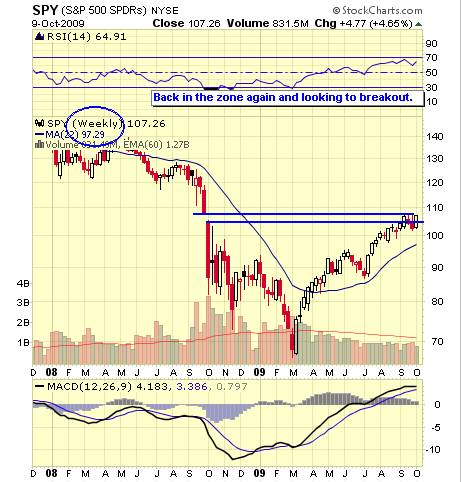
The DJIA was up 4% on the week, while the Nasdaq and the S&P each tallied a 4.5% rise. It's the best performance since July and lands the Dow at new 2009 highs. The weekly gains follow back-to-back weekly declines. This cannot last. It's been straight up, since the March low and Sector P/E ratios are rising.

But, say the bulls, it's only recovered 45%, compared to a "normal" 72% recovery from previous stockmarket bottoms. We have still a long way to go.

Aren't charts wonderful? The first one is a daily chart of the DOW. The second one is the weekly.
The BIG fear is that the stockmarket is disconnected from the realities of the world. The economy is doing awfully. The stockmarket is doing great. This confuses people and have many arguing if it's overvalued or not.
Sadly, it's not that simple. Moreover, this could be the most hated rally in Wall St. history.
For one, the econmy is doing surprisingly well in several areas: retail sales, technology, much corporate earnings, and this morning, a narrowing of the U.S. trade gap. Also, mortgage interest rates have fallen, making it cheaper to refinance your old house or buy a new one.
There remain two huge overhangs: Jobs. We've lost 7 million since December 2007. To get back to some semblan! ce of a normal economy, we'll need to create 12 to 15 million ! jobs over the next five years. That will be a hard job.
Second, commercial real estate . It's way in the toilet. At least $1.5 trillion of loans by banks and others are under water. The banks are afflicted with The Egypt Syndrome -- denial, denial, denial. They're keeping the loans on their books. They're not selling them, not dealing with them. Their fear is if some loans are written down to their real value, all loans will be forced to be written down. And their balance sheets will then violate fed capital requirements and they'll be closed down. The reality is they will be written down. And several hundred banks will be closed in ! the next two years. (Just under 100 have been closed this year.) FDIC estimates closing another 100 in 2010.
Commercial rents have cratered. Many buildings are in default on their loans, or soon will be. The banks are not dealing with the mess, but will have to soon. The next shoe to fall will be real estate stocks and REITs. Friends are shorting REITs. This piece HERE from the Wall Street Journal's MarketWatch this week is instructive.
Many people also believe the declining U.S. dollar is a problem. It is and it isn't. You ha! ve to factor it into your investment decisions. Companies t! hat expo rt will do better. Some overseas countries will do well, viz Australia, Brazil. Canada and -- of all places -- Poland. The Australian dollar is now at 90 U.S. cents. A few months ago, it was under 60 cents.
But sentiment, not logic, is what drives the stockmarket.
And, now there are many people from Jim Cramer to Byron Wien to Barton Biggs pounding the table for equities, even though S&P is up 60% from March.
Which brings me to the importance of cycles. In January, Howard Marks, the brilliant head of Oaktree Capital ($60 billion under management) wrote about the inevitability of boom and bust business cycles. He concluded we're stuck with them forever. He wrote:
Of all the investment adages I use, this one remains the most important: "What the wise man does in the beginning, the fool does in the end." Practices and innovations often move from exotic to mainstream to overdone, especially if they're initially successful. What early investors did safely, the latecomers tried in 2003-07 with excessive leverage applied to overpriced and often inappropriate assets.
Under the heading of "the Importance of Cycles," he wrote:
In my opinion, there are two key concepts that investors must master: value and cycles. For each asset you're considering, you must have a strongly held view of its intrinsic value. When its price is below that value, it's generally a buy. When its price is higher, it's a sell. In a nutshell, that's value investing.
But values aren't fixed; they move in response to changes in the economic environment. Thus, cyclical considerations influence an asset's current value. Value depends on earnings, for example, and earnings are shaped by the economic cycle and the price being charged for liquidity.
Further, security prices are greatly affected by investor behavior; thu! s we can be aided in investing safely by understanding where we stand in terms of the market cycle. What's going on in terms of investor psychology, and how does it tell us to act in the short run?
We want to buy when prices seem attractive. But if investors are giddy and optimism is rampant, we have to consider whether a better buying opportunity mightn't come along later.You can read his entire paper on the Oaktree Capital web site. Click here.
bikini actress star, wallpapers fitness,
